> ## Documentation Index
> Fetch the complete documentation index at: https://learn.art-opia.com/llms.txt
> Use this file to discover all available pages before exploring further.
# Import your collection to Artopia
> Bring your existing art collection into Artopia from CSV or Excel with the built-in importer, or migrate from Artlogic, Artwork Archive, Art Record, and other tools.
 If your collection already lives somewhere else, a spreadsheet, a folder of images, or another collection-management tool, you can bring it into Artopia. If you have a CSV or Excel file you can import it yourself in a few clicks. For anything more complicated, our team is happy to migrate it for you.
## Import from a CSV or Excel file
You can import up to **1,000 artworks at a time** from a CSV or Excel file.
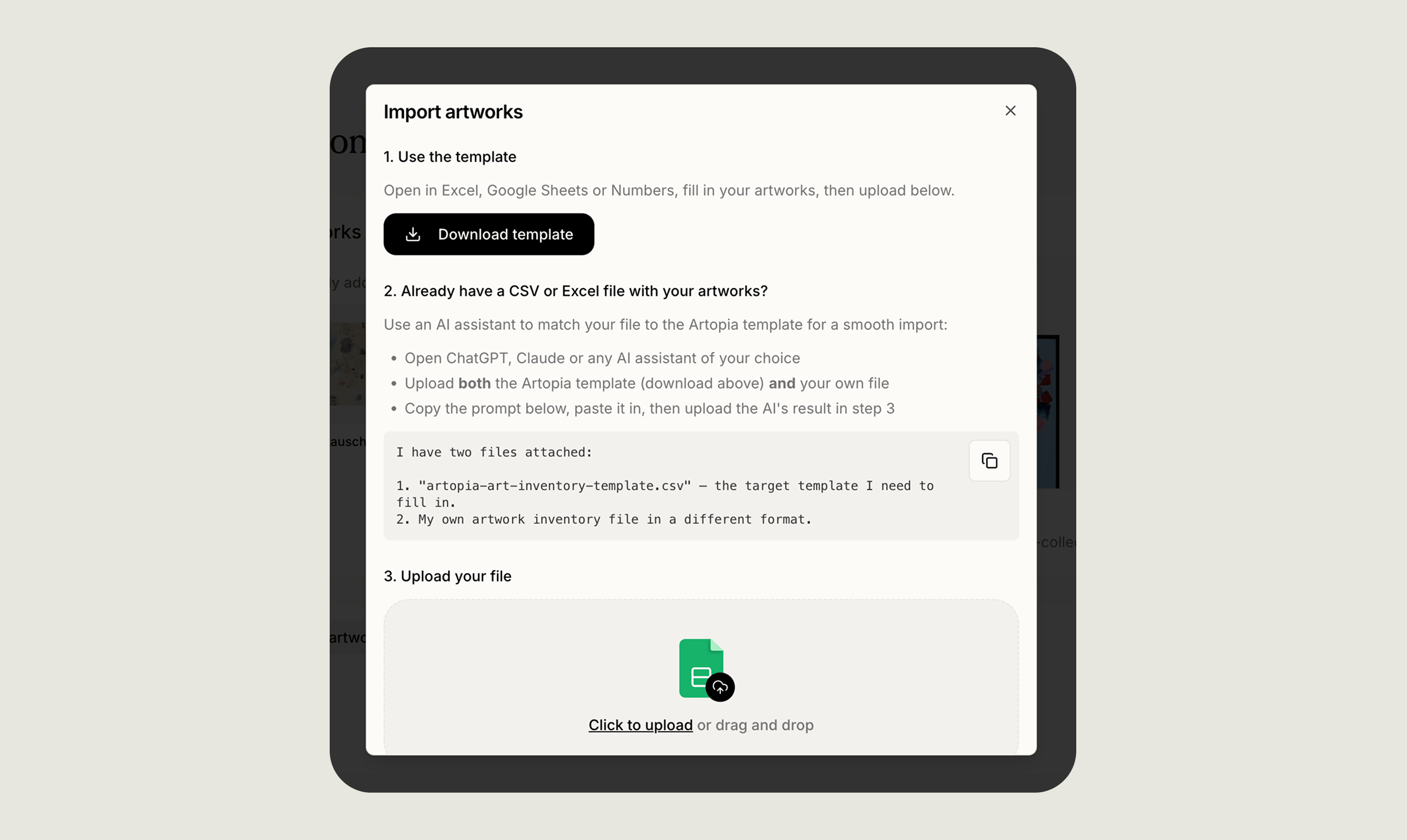
In the sidebar, open the **New** menu and choose **Import artworks**. The whole process happens in a single window on top of whatever page you're on.
### Step 1. Get the template
Click **Download template** in the import window to save Artopia's template file. Open it in Excel, Google Sheets, or Numbers and fill in one row per artwork. The template has 11 columns, in this order:
| Column | What to put in it |
| ------------------ | ------------------------------------------------------------------------------------------------------------------- |
| **Artist** | If left blank, the artwork imports as `Unknown` with a soft warning. |
| **Title** | Up to 200 characters. If left blank, the artwork imports as `Untitled` with a soft warning. |
| **Creation Date** | Free text. A year, a range, or something like "1970s" all work. |
| **Medium** | Free text, e.g. "Oil on canvas". |
| **Height** | A number. |
| **Width** | A number. |
| **Depth** | A number. |
| **Unit** | `cm` or `in`. Leave blank to use the default unit from your profile. |
| **Purchase Price** | A number. |
| **Currency** | A standard currency code like `USD`, `EUR`, or `GBP`. Leave blank to use your default currency when a price is set. |
| **Purchase Year** | A four-digit year. |
Keep all 11 column headers in the file, even the ones you leave empty. If any headers are missing, Artopia will refuse the file and tell you which columns to add back.
If you're starting fresh, fill in the template directly and skip to step 3.
### Step 2. Already have your own spreadsheet? (optional)
If your existing file uses different column names, the fastest way to reshape it is to hand it to an AI assistant along with Artopia's template:
ChatGPT, Claude, or any other AI assistant that lets you upload files.
Add the Artopia template and your own spreadsheet to the same conversation.
In the import window, click the copy icon next to the step 2 prompt and paste it into the AI.
Save the file the AI gives you back, and use that in step 3.
Artopia doesn't run the AI itself, this is something you do outside the app. If the AI produces a currency code Artopia doesn't accept, you'll simply see an error in the preview and can fix it before importing.
### Step 3. Upload your file and check the preview
Drop your file into the upload area or click to browse. Artopia accepts **CSV, XLSX, and XLS** files, and it automatically ignores any empty rows at the end.
Once the file is uploaded, you'll see a preview of every row with its artist, title, and a **Status** column. Each row is marked as:
* **✓ Ready**, the row is good to import
* **⚠ Warning**, the row will import, but with a default value filling in a missing field
* **✗ Error**, the row has a problem that needs to be fixed before you can import
You'll also see a **New artists to be created** section listing any artist names in the file that don't match artists you already have.
The import button at the bottom shows the exact number of artworks that will be created, e.g. **Import 42 artworks**.
#### Warnings vs. errors
**Warnings** just mean Artopia will fill in a default for you:
* Blank **Title** becomes `Untitled`
* Blank **Artist** becomes `Unknown`
* Blank **Unit** uses the default unit from your profile
* Blank **Currency** (when there is a price) uses your default currency
**Errors** stop the import until you fix them. The whole file imports as a single batch, so even one error will block everything else. You'll see errors when:
* A title is longer than 200 characters
* A **Unit** value isn't `cm` or `in`
* **Height**, **Width**, **Depth**, or **Purchase Price** contains something other than a number
* A **Currency** code isn't recognised
* **Purchase Year** isn't a four-digit year
The first five errors are shown right away, and you can expand the list to see the rest. Fix them in your spreadsheet and upload the file again. Nothing is saved to your collection until every row is clean (or only has warnings).
Before you confirm, glance down the **New artists to be created** list and look for near-duplicate spellings, for example `Cy Twombly` vs. `cy Twombly`. Any name in that list will create a brand-new artist record, so it's worth catching typos here.
### Step 4. Confirm the import
When everything looks right, click **Import N artworks**. Artopia will show a spinner with the message *"Importing N artworks… Please don't close this window."* Small files import almost instantly; larger files usually take a few seconds.
When it's finished, you'll see a confirmation like *"Import complete, N artworks added, M new artists created"*, and Artopia will jump to your **Artworks** list so you can look through the new entries right away.
Imports **can't be undone**, and Artopia doesn't check for duplicates. Uploading the same file twice will create two copies of every artwork. If something goes wrong, you can clean up with [bulk actions](/features/bulk-actions).
## Limits and edge cases
* **File size**, up to 1,000 artworks per file. If your spreadsheet is bigger, split it and import in batches.
* **Plan limits**, if an import would take you over your plan's artwork limit, Artopia won't save anything and will invite you to upgrade instead.
* **Empty files** get an *"Empty file"* message so you know nothing was uploaded.
* **Something goes wrong mid-import?** You'll see *"Import failed, nothing was saved"* with **Retry** and **Back to preview** buttons. Your collection stays untouched until the import fully succeeds.
## Migrating from another tool
Moving to Artopia from another platform? Email us at [app@art-opia.com](mailto:app@art-opia.com) and we'll take care of it. We've helped collectors migrate from all sorts of places, including:
In Artlogic, go to **Artworks → Create… → Export…** and pick a CSV export. Send us the file and we'll handle the rest.
Go to **Artworks → Pieces**, click **New Report**, and choose **Export to CSV**. Send the file to us.
Open the settings page and choose **Download Entire Archive**. Art Record will email you a ZIP file with your data after about a day. Forward that to us.
Excel, Google Sheets, a folder of images, an Instagram feed, another collection app, we've probably worked with it before. Get in touch and we'll figure it out with you.
If you have any other questions, reach us at [help@art-opia.com](mailto:help@art-opia.com).
## Related topics
- [Export your data from Artopia](/features/exporting-data.md)
- [Welcome to Artopia](/learn/welcome-to-artopia.md)
- [Your public collection](/features/public-collection.md)
If your collection already lives somewhere else, a spreadsheet, a folder of images, or another collection-management tool, you can bring it into Artopia. If you have a CSV or Excel file you can import it yourself in a few clicks. For anything more complicated, our team is happy to migrate it for you.
## Import from a CSV or Excel file
You can import up to **1,000 artworks at a time** from a CSV or Excel file.
In the sidebar, open the **New** menu and choose **Import artworks**. The whole process happens in a single window on top of whatever page you're on.
### Step 1. Get the template
Click **Download template** in the import window to save Artopia's template file. Open it in Excel, Google Sheets, or Numbers and fill in one row per artwork. The template has 11 columns, in this order:
| Column | What to put in it |
| ------------------ | ------------------------------------------------------------------------------------------------------------------- |
| **Artist** | If left blank, the artwork imports as `Unknown` with a soft warning. |
| **Title** | Up to 200 characters. If left blank, the artwork imports as `Untitled` with a soft warning. |
| **Creation Date** | Free text. A year, a range, or something like "1970s" all work. |
| **Medium** | Free text, e.g. "Oil on canvas". |
| **Height** | A number. |
| **Width** | A number. |
| **Depth** | A number. |
| **Unit** | `cm` or `in`. Leave blank to use the default unit from your profile. |
| **Purchase Price** | A number. |
| **Currency** | A standard currency code like `USD`, `EUR`, or `GBP`. Leave blank to use your default currency when a price is set. |
| **Purchase Year** | A four-digit year. |
Keep all 11 column headers in the file, even the ones you leave empty. If any headers are missing, Artopia will refuse the file and tell you which columns to add back.
If you're starting fresh, fill in the template directly and skip to step 3.
### Step 2. Already have your own spreadsheet? (optional)
If your existing file uses different column names, the fastest way to reshape it is to hand it to an AI assistant along with Artopia's template:
ChatGPT, Claude, or any other AI assistant that lets you upload files.
Add the Artopia template and your own spreadsheet to the same conversation.
In the import window, click the copy icon next to the step 2 prompt and paste it into the AI.
Save the file the AI gives you back, and use that in step 3.
Artopia doesn't run the AI itself, this is something you do outside the app. If the AI produces a currency code Artopia doesn't accept, you'll simply see an error in the preview and can fix it before importing.
### Step 3. Upload your file and check the preview
Drop your file into the upload area or click to browse. Artopia accepts **CSV, XLSX, and XLS** files, and it automatically ignores any empty rows at the end.
Once the file is uploaded, you'll see a preview of every row with its artist, title, and a **Status** column. Each row is marked as:
* **✓ Ready**, the row is good to import
* **⚠ Warning**, the row will import, but with a default value filling in a missing field
* **✗ Error**, the row has a problem that needs to be fixed before you can import
You'll also see a **New artists to be created** section listing any artist names in the file that don't match artists you already have.
The import button at the bottom shows the exact number of artworks that will be created, e.g. **Import 42 artworks**.
#### Warnings vs. errors
**Warnings** just mean Artopia will fill in a default for you:
* Blank **Title** becomes `Untitled`
* Blank **Artist** becomes `Unknown`
* Blank **Unit** uses the default unit from your profile
* Blank **Currency** (when there is a price) uses your default currency
**Errors** stop the import until you fix them. The whole file imports as a single batch, so even one error will block everything else. You'll see errors when:
* A title is longer than 200 characters
* A **Unit** value isn't `cm` or `in`
* **Height**, **Width**, **Depth**, or **Purchase Price** contains something other than a number
* A **Currency** code isn't recognised
* **Purchase Year** isn't a four-digit year
The first five errors are shown right away, and you can expand the list to see the rest. Fix them in your spreadsheet and upload the file again. Nothing is saved to your collection until every row is clean (or only has warnings).
Before you confirm, glance down the **New artists to be created** list and look for near-duplicate spellings, for example `Cy Twombly` vs. `cy Twombly`. Any name in that list will create a brand-new artist record, so it's worth catching typos here.
### Step 4. Confirm the import
When everything looks right, click **Import N artworks**. Artopia will show a spinner with the message *"Importing N artworks… Please don't close this window."* Small files import almost instantly; larger files usually take a few seconds.
When it's finished, you'll see a confirmation like *"Import complete, N artworks added, M new artists created"*, and Artopia will jump to your **Artworks** list so you can look through the new entries right away.
Imports **can't be undone**, and Artopia doesn't check for duplicates. Uploading the same file twice will create two copies of every artwork. If something goes wrong, you can clean up with [bulk actions](/features/bulk-actions).
## Limits and edge cases
* **File size**, up to 1,000 artworks per file. If your spreadsheet is bigger, split it and import in batches.
* **Plan limits**, if an import would take you over your plan's artwork limit, Artopia won't save anything and will invite you to upgrade instead.
* **Empty files** get an *"Empty file"* message so you know nothing was uploaded.
* **Something goes wrong mid-import?** You'll see *"Import failed, nothing was saved"* with **Retry** and **Back to preview** buttons. Your collection stays untouched until the import fully succeeds.
## Migrating from another tool
Moving to Artopia from another platform? Email us at [app@art-opia.com](mailto:app@art-opia.com) and we'll take care of it. We've helped collectors migrate from all sorts of places, including:
In Artlogic, go to **Artworks → Create… → Export…** and pick a CSV export. Send us the file and we'll handle the rest.
Go to **Artworks → Pieces**, click **New Report**, and choose **Export to CSV**. Send the file to us.
Open the settings page and choose **Download Entire Archive**. Art Record will email you a ZIP file with your data after about a day. Forward that to us.
Excel, Google Sheets, a folder of images, an Instagram feed, another collection app, we've probably worked with it before. Get in touch and we'll figure it out with you.
If you have any other questions, reach us at [help@art-opia.com](mailto:help@art-opia.com).
## Related topics
- [Export your data from Artopia](/features/exporting-data.md)
- [Welcome to Artopia](/learn/welcome-to-artopia.md)
- [Your public collection](/features/public-collection.md)